



How former military man is transforming hockey through Kisumu Queens




.jpg)




Reading Time: 5min | Tue. 20.05.25. | 21:45
Behind this team’s remarkable rise is coach and founder Brian Aduda, a man whose love for hockey and desire to give back to his community are transforming the sport for women in western Kenya
When Kisumu Queens dipped their feet into uncharted territory by making their debut in the Kenya Hockey Union (KHU) Women’s Premier League, many expected them to be the punching bags, playing for survival.
Follow our WhatsApp channel for more news
Few predicted they would be the team to stun giants like USIU-A and push defending champions Blazers to a goalless draw. But five matches in, with three wins, one draw, and only one loss, Kisumu Queens have shown they are not here just to fill the numbers—they are here to compete.
Behind this team’s remarkable rise is coach and founder Brian Aduda, a man whose love for hockey and desire to give back to his community are transforming the sport for women in western Kenya.

Aduda’s journey is steeped in hockey. After coaching Lakers Hockey Club to promotion into the Premier League in 2018, he stepped aside, feeling that his vision as a coach was not aligning with the club’s direction.
“I felt that if I formed a club, it would be run better,” said Aduda. That feeling became the foundation of Kisumu Queens in 2021.
But before forming the team, Aduda took a rare route, he went back to the drawing board. “I took a break from coaching and started researching how to run a club,” he recalls.
His goal was not just to field a team, but to build a sustainable and developmental structure that empowers young women through hockey.
Scouting the Region for Raw Talent
Recruitment was unlike any other in Kenyan hockey. Aduda, with the help of coach Stanslaus Ochan, travelled across the Western and North Rift regions, visiting universities, teacher training colleges, and polytechnics.
“Our target was to recruit players who had never played club hockey,” he says. Players from Masinde Muliro University, Maseno University, and other institutions joined the trials. Over 30 girls were selected to form the first squad.
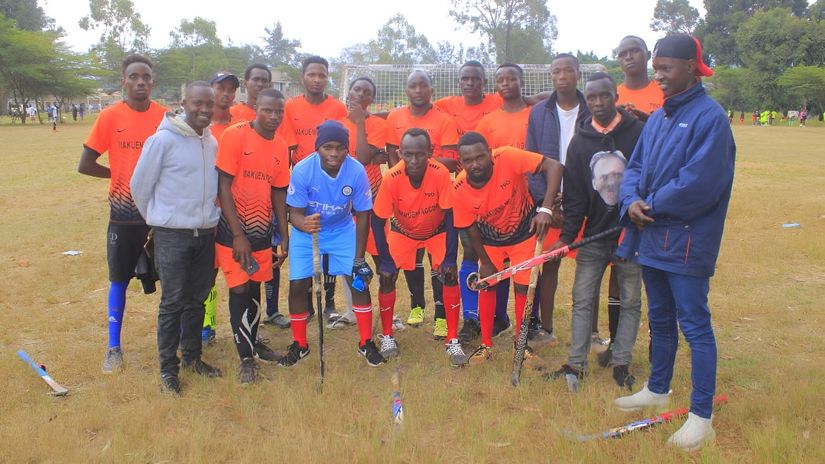
In 2022, the club focused on playing tournaments rather than joining the league. “We weren’t ready,” Aduda admits. “We used those games to learn player positions and understand each other.”
The decision has paid off handsomely. When Kisumu Queens finally joined the KHU Women’s Super League in 2023, they finished fourth. Disappointed but not defeated, the girls returned stronger in 2024 and went unbeaten to earn promotion into the Premier League.
Now in the top tier, Kisumu Queens have stunned many. “We’ve only lost one match, the opener against Lakers, and that was due to inexperience,” says Aduda.
Since then, they have defeated Amira Sailors and Kenyatta University away in Nairobi, won at home against USIU-A, and held Blazers to a 0-0 draw.
That draw against Blazers might be their biggest statement yet. “They were lucky to walk away with a point,” Aduda says confidently.
With six goals scored and just three conceded, the team is slowly morphing into the league’s surprise package.

Yet Aduda remains grounded. “I keep telling my players not to worry about winning the league—just don’t get relegated.” Still, he believes the future is bright. “If I keep this team together for three years, I will win the Premier League.”
Unlike many modern coaches who emulate European hockey systems, Aduda focuses on individual player talent. “I don’t believe so much in European systems, I rely on the players to defend and attack as a team. I build around their natural abilities.”
To support his squad, he brings in a variety of experienced coaches to work with the team, including national team tactician Joseph Osino, Dennis Owoka, Kamal Sembi, and Aloys Owino. “Different voices help the girls understand the game better,” he explains.
Mentorship Beyond the Pitch
For Aduda, coaching goes beyond hockey. “These girls are young, so I have to step up as a mentor and father figure,” he says. From lifestyle talks to conversations about avoiding early pregnancies, his approach is holistic. “We have life sessions before training. It makes us more of a family.”
That personal touch is one reason the team has gelled so quickly, despite players coming from as far as Kitale, Bungoma, Bondo, Siaya, and Kakamega. The girls travel to Kisumu for training every weekend, a financial and logistical challenge that underscores their commitment.
Forming a second women’s team in Kisumu was no easy task, especially in a sport still seen as elite and not widely understood by the general public.

“Most people support Lakers because they’re used to having just one women’s team in Kisumu,” says Aduda. “But now, with Kisumu Queens, there’s competition and that’s healthy for the sport.”
The rivalry is already bringing out the best in both teams, and Aduda hopes more clubs will emerge from the region. “I want someone else to start another team here. We need more women’s teams to grow the game.”
Finances and the Struggle to Stay Afloat
As with many sports teams in Kenya, funding is a constant struggle. “We have friends and former players who support us - some from the USA, UK, and Australia,” says Aduda. “We have a WhatsApp group where we fundraise year-round. But often, I have to dig deep into my own pockets.”
The team holds one major harambee annually, but it is hardly enough. “The girls have personal needs outside of sport, and I help where I can,” he says. Despite the challenges, the team has continued to rise.
Aduda dreams of a future where corporates support not only clubs like Kisumu Queens but also the national teams. “In the USA and UK, corporates ensure teams are well-prepared as part of their social responsibility. Here, we rely too much on government support, and that’s not enough.”
Giving Back Through Hockey
For Aduda, Kisumu Queens is more than just a club - it is a legacy project. “Hockey gave me everything,” he says, recalling how the sport helped him get recruited into the military in 1991, a move that later helped him land his job with the United Nations.

“This is my way of giving back to the community by empowering girls through sport.”
And as Kisumu Queens continue to impress in their debut Premier League season, it is clear that Aduda’s vision is not just noble - it’s working wonders.
They may be newcomers, but with their discipline, talent, and hunger, they are already reshaping the landscape of women’s hockey in Kenya.
“We want to be competitive and avoid relegation,” Aduda reiterates. But the team’s performance so far suggests they might achieve far much more. If the club’s philosophy remains intact and support grows around them, Kisumu Queens could become one of the dominant forces in Kenyan hockey.
“I’m not sure where we’ll finish,” says Aduda. “But give me three years with this squad, and we’ll be champions. That won’t be a surprise.”